
Enter any keyword(s) to search our Blogs.
From Fear to Freedom: How One Family Conquered Sleep Regressions—Twice
When this family first considered sleep coaching, their son was just 7 months old. Sleep wasn’t perfect—but it felt manageable. What stopped them from seeking help wasn’t uncertainty about sleep itself; it was fear.
Fear fueled by misinformation.
“We actually tried approaching sleep training at 7 or 8 months… but there was a lot of misinformation with the cry-it-out method, and that really scared us.”
So they waited. Like many parents do.
They relied on what worked in the moment—rocking, bottles, pacifiers, co-sleeping. Over time, though, those supports stopped working. By 15 months, their son was waking every 30–45 minutes, needing a bottle each time to fall back asleep.
“There was no sleep at all for those 3–4 months… He was drinking so much milk at night that he wasn’t even hungry for solids in the morning.”
They were exhausted, discouraged, and ready for an option that aligned with their values.
Gentle Sleep Coaching at 15 Months: The First Breakthrough
When we began working together, one thing mattered most to them: this could not be cry-it-out.
We moved slowly and intentionally. I explained the science behind sleep, how sleep pressure and circadian rhythm work together, and why reducing sleep crutches doesn’t mean abandoning a child.
“Joanna was very systematic. She made it clear this was not cry-it-out. It was a slow transition. We had to trust the process—and we did.”
And it worked.
Their son learned how to fall asleep independently.
He slept through the night.
He ate better during the day.
He woke up joyful.
“Now we see him waking up with a smile and going to bed happily. I can’t imagine life before this stage.”
What Causes Toddler Sleep Regression? Illness, Travel, and Big Changes
Just when things felt solid, life threw everything at them at once:
Hand, foot, and mouth disease
A new pregnancy
A major relocation
“All those sneaky sleep crutches we had completely eliminated—boom, they were back.”
At 22 months, they were facing frequent night wakings, bottles overnight, and a very overtired toddler. Even though they had already succeeded once, starting again felt vulnerable.
But this time, something was different.
“We made a whoops and a boo-boo and needed help again. But our confidence level was sky-high.”
Why the Second Sleep Reset Was Faster and Easier
Because they already understood the process, the second round of sleep coaching moved quickly—even with travel and mom being very pregnant.
“It was like sleep training an entirely new baby… but we had the process, so it was easier.”
Within days:
Sleep consolidated
Naps returned
And their son began asking to nap
“He literally walks to his bedroom, says ‘nap time,’ and asks to go into the crib.”
Life on the Other Side
Today, bedtime and naps are calm and predictable:
No bottles
No rocking
No resistance
Dad is fully involved.
Grandparents can handle bedtime confidently.
Everyone is sleeping—including mom, just weeks from delivering another baby.
“We finally get to eat together again. We hadn’t seen a movie in two years.”
“It feels like a privilege to put him to bed.”
Watch their full video story here:
Sleep Regression Doesn’t Mean Sleep Training Failed
If sleep unraveled after it was working, you didn’t fail—and neither did your child.
Regression during illness, travel, developmental leaps, or major life changes is normal. The key is knowing how to respond without panic and without undoing the skills your child already has.
How to Reset Sleep Gently (Without Cry-It-Out)
A Sleep Strategy Session is a 60-minute Zoom call where we:
Assess your child’s sleep history
Identify what caused the regression
Decide whether you need a reset or deeper support
Already Sleep Trained—but Stuck?
I created a Sleep Regression Guide specifically for families whose children already have good sleep skills but need a refresh during:
Illness
Travel
Developmental changes
Big life transitions
Download the Sleep Regression Guide
You’re not back at square one.
You’re just at a reset point—and support makes all the difference.
-
Hello, I'm Joanna with blissful baby sleep coaching. And we're here with another success story, their son. They first came to me when their son was 15 months old. We totally successfully sleep trained him and nap trained him, and it was awesome, right? Yeah. And then little guy got really sick with hand, foot and mouth. They were also in a big transition with possibly moving. And so all those sneaky sleep crutches that we had completely eliminated, boom, they were back.
Yes. We actually then had to do a second session, if you will, of sleep training again when he was two months old. 24 months old. 22 months old. 22 months old, yes. So as we're going through the sleep success story, I just wanted everyone to kind of understand that they've got two really unique perspectives on doing sleep coaching with a 15 month old and doing a sleep coaching with a 22 month old, which are two entirely different creatures.
So my first question always is, what was life like before you called me? Yeah. So we actually tried approaching you at seven, eight months when our baby was that old. And there was a lot of misinformation with cry it out method. And that was something that really scared us. And then we ultimately decided to not go through with it. And life at the time seemed okay. Like we were involuntarily bringing on a lot of crutches just to make him sleep and keep him asleep, which we didn't know at the time that we were doing like we were rocking, we were singing, we're doing like a bunch of things, which seemed harmless, which is harmless.
And we had the bottle, we had the pacifier, we had like a bunch of things that were going on to try and get him to stay asleep. And we continue to do that for a year, until he was a year. And then we had a big trip where we co slept for like a month and a half or something. And after that he just would not go back to his crib.
And it. It was almost two to three months until he was 15 months that we had to go through that process where he was asleep with us in the bed at first, but then he'll keep on waking up during the night. So he will only sleep for about 30 to 45 minutes at a time. And then he wake up and he'll ask for a bottle and then he fall asleep on the bottle.
And what ended up happening was he was having just so much milk at night that he was not eating enough in the morning time. So like whenever we would try to introduce food, solid foods, he would just not Accept it because he was getting all of those calories at night. And so it was like a pretty bad cycle of giving him the bottle, trying to keep him asleep for both of us.
There was no sleep at all for the three, four months that we went through it. Yeah. And then ultimately we kind of went back and we looked at Joanna for help. Yeah. And Dad, I also remember during that time that maybe, like, it was getting harder for you to help him with go to sleep or go back to sleep. Wasn't he kind of getting mommy preferenced where your son was like, even though you were co sleeping and doing all the things, he was always, like, wanting mom instead of like, you?
Yeah, yeah. No, I think it was. It was super hard, you know, almost so much so that I was like questioning, like, come on, like, baby, why are you not sleeping with me? But. But yeah, it was super hard. And I think we were not sleeping enough like Utra said. And, you know, that was making us irritable as well. So it was. Don't imagine that life again. Yeah, exactly.
Yes, exactly. Like just irritable. And nothing was working. Okay. And then mom, you had said that you, you know, initially at seven months, you were like, I don't want to do cry it out. That's all I see in the marketplace. Yeah. That's why you didn't make any changes at seven or eight months. But then here you are at 15 months now you're desperate. Like, now you've gone way down.
Like, your ability to tolerate what's going on. Like dad said, like, highly irrit. No sleep. Yeah. So then you were like, all right, I've got to find an alternative to cry it out. So you found me because I'm a gentle sleep coach. And so what was it like to, you know, get that support, that. How did that feel for you to. So I think first of all, what I want to say is that Joanna is very systematic.
Like, so even before we started the coaching, I remember that you had asked us to do like a log of everything that he does. So that kind of first of all gave us the idea that we are in the right path. Like, you know, we are working with someone who actually knows what to do and like it. You made it very clear that this was not a cry it out method.
This was a slow transition. And of course we had to keep an open mind that there is, whenever there is transition, whenever there is change, a baby is going to resist. So we, we had to trust that and we went with the flow at the time to, you know, Kind of get that understanding in because we didn't know that we had introduced all of these crutches that were crutches.
Like, we didn't even know. We just thought that was just part of how a baby sleeps because everybody does it. Yeah. So I think that's. That was one thing that immediately kind of hit that once you started with the coaching process, we kind of got the understanding of what we are supposed to do, the bare minimum things that we're supposed to do versus everything else that we were doing.
But. Yeah. Do you want to add something else? Yeah, no. I mean, it was, it was crazy. Like, you know, I even learned about, like all the different cycles of sleep. Like, you know, who knew like all of that existed? Right. So when you start learning a little bit more about the science behind, you know, what happens and why it happens, I think it sort of gets you to a stage of then starting to figure out, okay, now how do we use that understanding, you know, to give the baby, you know, what he really needs, which is a good amount of sleep so that he's actually excited.
Even he was not doing well. Like, he was irritable, like when he would be up. Like, I mean, now we see him, you know, after that he's deep trained, like waking up with a smile and like going to bed, like happily. Like, you know, like I said, I can't imagine, you know, life before the stage. Yeah. Like, we're at the point now, you guys, where he literally reaches for his crib and he tells his parents that he is ready for his nap.
Yes, correct. Walking towards the bedroom, saying, it's nap time. Yeah. Not in a million years did anyone expect that result that, that, that we were able to use, you know, behavioral science and sleep science to really match it with what his needs were. Yes. Move in very, very incremental small steps. Yeah. You know, and like I said, like we did it once when he was 15 months and you guys had a great run where everything was great for several months and then the illness came and then you by accident reintroduced sleep crutches and this happened.
So I think it's an important topic because a lot of parents will say to me, oh, my God, if I do this with you, am I ever going to have to do it again? And I say, it depends. And they go, what? And I say, well, if we find out your child is highly sleep crutch prone, if you reintroduce the crutches for too long and consistently, like bedtime at, you know, each interval all night long, then yes.
That child will gladly take as many sleep crutches as you're willing to offer, and you will have what's considered a full sleep regression, meaning your child wasn't waking up at night, and now they're waking up again four or five times a night. Yeah. And that's what happened to you guys. And it was hard, but also knew you could come back to me for help. That there was no shame.
Yeah. There was no judgment. It was like, you know what? We made a whoops and a boo boo and we need help again. And when we worked again, like, your confidence level was, like, sky high. You're like, we know. Yeah. Yeah, exactly. I think that's. That's a very good point that, you know. First of all, during this age, right between one and two years, the baby's personality is changing every month.
So he definitely was not the same baby at 15 months as he was at 22 months when we started again. When we were, you know, during that phase of regression plus illness that we went through at 15 months, we kind of understood very quickly that we made the boo boo. Like, we should not have done those things because we've noticed it consistently that our baby thrives with consistency.
Like he wants a schedule. And having known that if he had just been a little more resistant to the changes that we were, because we actually introduced the changes, he probably didn't even need it. So that was like, a lesson that we learned after the fact that, okay, we made this mistake, but we know exactly what we did wrong that got us here. And I think at the time, I was also pregnant, and there was, like, some priorities in terms of, like, emotionally I was just unable to hear him cry.
So, like, I felt the need to go and grab him and just stop the cries for, you know, even a little bit. So I think it was kind of an emotional time as well for me that we thought, okay, you know, it's okay. The main thing is that he sleeps, and I don't care for now. So we'll just do what we do, and then we'll figure out once he's a little more, you know, aware, and then, you know, we reintroduce it.
So now, like, when do we know that? What is the right time to do it again? So I guess, you know, that's also important to know that, you know, your baby will actually tell you in many ways that he wants to sleep better. And like he said, the main change that we noticed was that he was a happier baby when he was sleeping through the night. And and then, like, we started noticing that he was just getting really, really cranky.
And, like, he was, you know, very irritable. You know, he was not happy at all. At bedtime, he would wake up grumpy. And at 22 months, like, he was also having a speech burst at the time. So we kind of figured out that this is the right time to do it, even from, like, very heavily pregnant point of view, that we wanted to make sure that before the second baby, yes, he is sleep trained.
And that was kind of the window that we found that this is, like the perfect window right now that we give him a couple of months and he will be able to master it. And we saw, like, the things that we did the first time around, and we incorporated a lot of those now. But I want to reiterate that he was not the same baby. He was an entirely different baby at 15 months, and he was an entirely different baby at 22 months.
So it was like sleep training, an entirely new baby. But we knew the process, so it became easier for us to actually go through with it. And we made success pretty soon. And that is the most important thing. So. Yeah. Yeah. And exactly. And again, if there's ever a regression, parents will also say, okay, well, if I have to sleep train again, like, how quickly can they learn?
And I say, very quickly. I mean, usually within a week, we're seeing massive improvement. Yes. And then towards full mastery, where you're getting the beautiful, you know, life that you're getting now. You know, I mean, within two weeks. And now it's been six weeks where he's sleeping through the night and taking impeccable naps. So why don't you tell everyone what sleep looks like now? So it's amazing. First of all, there are no res.
There is no resistance to wanting to go to sleep. He knows it's part of his daily routine. He understands that there is, like, a pattern that he needs to follow, and he's happily doing it. He plays when he plays, and when it's time to sleep, he understands that he has to sleep. And he, you know, we start his night routine at around, you know, 6, 30ish, typically. And he knows, like, once the night routine has started, you know, this is the pattern.
Like you do A, B, C. Like, it's kind of like that. And then he has to go into the crib and then he has to fall asleep. And there are days when he would just be like, I, I just want to go to sleep. And he will tell us that, you know, you can just Put me in the crib and bye. Bye. So he's gotten to that stage in the afternoons.
He's like his own nap captain. He will be like at 12:30, he's like, okay, bye, I'm done. And then he'll just go inside to sleep. So yeah, he's gotten really good at it. He sometimes will have some arousals in between. Like if he's startled by a sound or something, he would wake up. But then now we are known to the process and you know, we know not to disturb him.
So he has mastered his sleep skills so well that he can actually now go back to sleep on his own. And you know, those, those things are important to know as parents. And I think first time parents, we are, you know, overly cautious. You know, he's sleeping so well, but we still have the baby monitor on all the time and we are still, you know, constantly watching him.
We don't have to anymore, but we still do it. And so like we, we see that, you know, even if he tosses and turns and you know, there are times that he'll actually sit up and he'll just look around, but then he'll fall asleep again. So like that's, that's, that's like great transition that we are seeing now in our baby and like amazing mood. So it's, it has so many benefits.
Like his mood is great, he's eating well, which was another, you know, point of concern that we had initially. His, you know, milk intake has gone really down, which is another thing that we wanted, like, we wanted him to have other foods and not just rely on milk. So yeah, so all of those things like, are great positives that we have seen just from sleep training. Like there are so many things that are interrelated to one part.
And I think you also said you got the speech burst. Yeah, yeah, that was a big one. Right? So like, you know, when your child's, you know, between 15 and 18 months, some speech starts coming and you guys were like, what? We want more, we want more speech. And then once we trained him again, like the speech started just, you know, pouring out, which is. Yeah, so if, like, so now we know that life is better.
We know that the second baby is coming any day now, which is amazing. The parents have been integrated. Dad, you've been integrated. So talk about what it was like to now be in a situation where like you can handle the everything. Like you, if, if mom's in the hospital and you're home with your son, like no problem. Like talk about that super Easy. Well, it was not the case like before we did this, but, you know, same thing, right?
Like, he knows when he wants to go back in and get his nap. Or like, you know, he knows when it's like, you know, sleep time at night. So the schedule is the same. Like, he does it now with any of us in the family, which is. Which is amazing because there used to be a preference that he had for mom. You know, it feels great to be able to do this with your son.
And, you know, that's, I guess, the. On the emotional side of things, like, you know, you feel good about it yourself in a way that you're able to do this and your son's been sort of able to spend time, know, with you, like, read a book, you know, get him to bed. I think all of that is. Sounds super simple, but it's. It's actually a privilege. It is a privilege.
And I often say to families, like, when. When you have a situation where you kind of had a mommy preference going on, the dad often feels like really on the periphery. Even though dad wants to be totally involved, the baby kind of creates this, like, barrier. It's kind of an invisible barrier. And so then the dad kind of has this feeling like, well, whenever I try to help, I actually make things wor.
Right. And so now the benefit of sleep training is what we get is dad and baby are bonded. Dad and baby trust each other. Dad and baby have their own cute little pattern. Dad gets to have that beautiful experience of reading the book. I mean, there's just never. There's nothing better than sitting with your kid on your lap reading a book, and then a final kiss. Put him in the crib, walk out the door and be like, it's 7:30.
Yeah. Yeah. I mean, it just is, right? I mean, it's such a massive accomplishment. Yeah, yeah, yeah. And I. I want to actually say, you had told me when we had started the process that he needs to have association with the routine and not the person. And not the person. Yeah. And that was something that we didn't really think how important it was at the time. Now we do that.
It really doesn't matter if I'm doing the routine or he's doing the routine or any of the grandparents is doing it or the neighbor is doing it. Like, he's actually fine. He go to sleep because he knows that he has to take a bath, he has to read a book, and then he has to go to the crib and he has to sleep all night. Like, he knows that.
So that's amazing. Amazing. So what's possible for you guys now that literally was not possible before working with me? Yeah. I think eating together is the main one for us. So we were never able to eat together at the same time for the longest time because one of us was always on call with our baby. And that's changed. Now we definitely get to spend some evenings together, which is amazing.
You know, just talk, actually about anything, which has been great. Yeah. Watch tv. Yeah. A bunch of different things that we had not caught upon over the last couple years, so. Yeah. Last couple years. Yeah. Oh, yeah. We had a lot to catch up in the last 20 years. Yeah. Yeah. Like, we hadn't seen a movie in two years, so. Yeah. So just getting able to start a movie and finish the movie the same night, that was like, wow.
I know, right? So simple pleasures. Okay, cool. So when you guys. If you guys ever bump into a family that is either scared to do sleep training or doesn't believe it's going to work for them because their case is too hard or they have a misperception that the only way to sleep train is cried out, like, what. What do you guys. I'd love dad to share first. Like, what do you guys want people to know about.
About it if they're like, I don't know. Yeah, we were just joking about it. Right. Like, you know, I'm gonna show him. Show the. Show the family, like our kid, you know, sleeping soundly and. And tell them that this is what is possible. Right. And you can actually go, you know, have dinner, watch a TV show or, like, watch a movie, like, while that's happening, and actually get your life in order.
And more importantly, get some sleep. If you want to get some sleep yourself and actually wake up with your kid and have the energy to play with the kid. So I think that's what is really possible. And having gone through this now a couple of times, I would say that we were actually apprehensive the first time ourselves. And it wasn't necessarily easy. We had to learn, we had to teach, and we had to go through the process.
So it's going to be a journey, and that's going to be the key. And it's really good for the baby, it's good for the parents, it's good for everyone else in the household, and, you know, that's ultimately what you want. Yeah. How about you, Mom? Yeah, I completely agree that it's a journey. It's going to be a slow transition. We had spoken about it initially as well, that Even though it's not a cry it out method, there are going to be some cries because our babies are smart, like they are going to be resistant to change.
They want, you know, things the easy way. They. So it's when, when we take some of those pleasures away, it's not going to be great. Like even as adults we don't like it. So. So it's going to be a slow transition. There are going to be some cries realistically. But like having gone through the process now and it's been like two months of a sleep trained baby, those four or five days in the initial days when we were sleep training him and there were some cries, they seem like a distant past now because the baby is just doing so well.
He is in great mood. He's, you know, doing well all over, all around. And I think when you look at that, it's like a small price to pay. But that's a price that we pay as parents because to be very honest, the baby is fine. Like we have to accept the fact that it's not, you know, a cried out method where they are completely abandoning the baby and just leaving them to fend for themselves.
Like that's not what we are doing here. This is a slow, easy, gradual process that is even acceptable for the child. Like they understand, they see you, they understand that there is a change going on. They are going to be resistant to the change at first, but I promise you that they will accept it and that this is great for them in a lot of ways. Exactly. And I think that's really important to say is that there is no such thing as a.
No. Yeah. No crying. And the way I like to, because the word crying can be very triggering. So it's like the word for me is more like level of protest. Like. Yeah. Are they protesting because they're frustrated? Are they processing because they're confused? Yeah. Protesting because you're being super inconsistent and they don't know what you're doing. So there's, you know, the way I work is really deep in decoding the nature of the protest so that we can respond appropriately.
And that's the key thing is always looking at what the trigger is and how we can respond appropriately in order to still make progress. Yeah. Still able to offer support, verbal support, physical support. We're physically in the room, we're available to them. Yeah. It's not giving them the crutch every single time. Yeah, yeah, exactly. Skills to be built. Yeah. Awesome. Well, thank you so much for sharing your story.
You're, you're two time, two time winner. And I think you have learned well and it will be great because now your baby's sleeping and now when you go to have, you know, your new family member coming any day now, you can do this with confidence that your child is home and sleeping well and anyone can put him to sleep, which is amazing. Yeah. Yeah. We are so excited about that.
This definitely was the main point of concern for us, you know, with. With a new baby coming in. So, yeah, I just want to say to the moms out there that, you know, just be patient. You know, we are all doing the best that we can. And, you know, this is a great option to actually consider because we are seeing the change in our baby that just sleep can bring.
So, like, sleep is connected to so many things of, you know, being well all around. And once we fix that small, tiny thing, it just changes to your baby. Yeah, exactly. Okay. Well, thank you so much. Yeah, thanks, Joanna. Okay.
Best Investment Ever: Hired Joanna for Both Kiddos.

Best Investment Ever. 2X Over
When parents experience real sleep—blissful, predictable, sustainable sleep—they want it for every child in their home.
That’s exactly what happened for Myra and her husband.
Not once.
Twice.
Working with a tenured sleep expert two times showed them something powerful:
sleep coaching doesn’t just change nights—it changes everything.
The First Time: Survival Mode
When Myra first reached out, her 18-month-old had never slept through the night.
They had just moved.
Started a new daycare.
Both parents were exhausted and barely functioning.
“We were struggling with meal prepping because we were so tired all the time. We were just getting takeout, spending too much money. Our house was a mess. We were having trouble concentrating at work,” Myra recalls. “Our son had behavioral issues because he wasn’t sleeping. Everyone was grumpy.”
They weren’t failing as parents.
They were sleep-deprived.
After a few weeks of tailored sleep coaching, everything shifted:
Their toddler slept through the night
Their home felt calmer
Their energy returned
And for years, sleep stayed solid.
The Second Time: Trusting the Process
When baby #2 arrived, they didn’t wait for rock bottom.
This baby was calmer—but still struggled with night wakings and naps.
And this time, Myra was also navigating postpartum depression and anxiety.
Her therapist was clear:
Healing requires consolidated sleep.
They reached out when their son was six months old—ready to begin.
But here’s the key difference with experienced, ethical sleep coaching:
Readiness matters.
He wasn’t quite there yet.
He had just started wearing a cranial helmet (causing overheating)
His mobility wasn’t fully developed
So we waited.
One month later—at seven months—he was ready.
That patience made all the difference.
(Assessing readiness—of both child and parent—is a core part of my Stairway to Sleep™ process.)
Why Customization Changes Everything
Sleep coaching is not one-size-fits-all.
Each child.
Each season.
Each family.
“What I love about working with Joanna is that we always had a tailored plan,” Myra says. “We knew exactly what to do, what to look out for, and how to adjust as we went along. That was so helpful.”
That flexibility allowed her to support her baby’s sleep and protect her mental health.
The Results: Life, Reclaimed
Today:
Two hands-free naps a day
Sleeping through the night
A calm, thriving household
Myra shared that…“I can actually have time for myself now. I can have a quiet dinner, go to bed early, take a shower, and just decompress,” she shares. “I was even able to attend a work conference in another state because my husband and our nanny could put both boys to sleep without an issue.”
She even traveled out of state for work, confident her husband and nanny could handle bedtime with ease.
And here’s the part that matters most:
With their first child, they had considered quitting their jobs and moving closer to family.
Once sleep improved?
They realized they loved their home, their new community, their careers, and their new life.
Sleep deprivation had been clouding everything.
“The Best Investment We Ever Made”
For parents on the fence, Myra says it best:
“We did this twice, with two very different kids at different ages, and both are still great sleepers years later. It was the best investment we ever made. Sleep deprivation clouds every aspect of life—your marriage, your work, your mental health. When that burden lifts, everything changes.”
Sleep isn’t a luxury.
It’s a foundation.
And with the right guidance, it’s absolutely within reach.
Ready to See These Benefits in Your Family?
Sleep coaching isn’t about control or discipline. It’s about creating the right environment and circumstance, using proven sleep science and attachment theory, and responding with sensitivity so your child can learn the essential skill of sleep. And in the process, your relationship grows stronger than ever.
Book your sleep strategy session and let’s determine the right next steps for your child and your family.
At Blissful Baby Sleep Coaching, I believe that sleep is a learned skill, and every child is capable of learning it—with the right guidance and support.
Whether you’re a working parent juggling deadlines or simply a family in need of rest, know this: there is always help and hope available.
If you’ve been hesitating, wondering if sleep coaching is right for you, let me reassure you: the hardest part is deciding to start. From there, with expert guidance and your dedication, the progress will come quickly. This is your chance to transform your life in a way few other things can.
Ready to take the leap? Let’s talk about how sleep coaching can create your family’s transformation. You deserve this. Your baby deserves this. And your future self will thank you.
Let’s start with an easy first step, schedule a Sleep Strategy Session so me, you and your partner can have an 1 hr long zoom session so I can properly assess the sleep situation and determine if you need one-on-one sleep coaching support.
Let’s get your baby sleeping—and get YOU your sanity back.
If you are still wondering if I can help, please know I do NOT advocate 'cry-it-out'. I am a Gentle Sleep Coach. If you want to learn about my guilt-free and gentle process, please go to these links.
The Blissful Baby Stairway to Sleep
Please join my Sleep is Bliss Tribe in Facebook, Instagram and LinkedIn so we can stay connected and you can continue to get amazing resources on sleep and family wellness.
Sleep is Bliss, Let's Get you more!
Spring Daylight Savings 2026: How to Gently Help Your Child Adjust When We “Spring Forward”
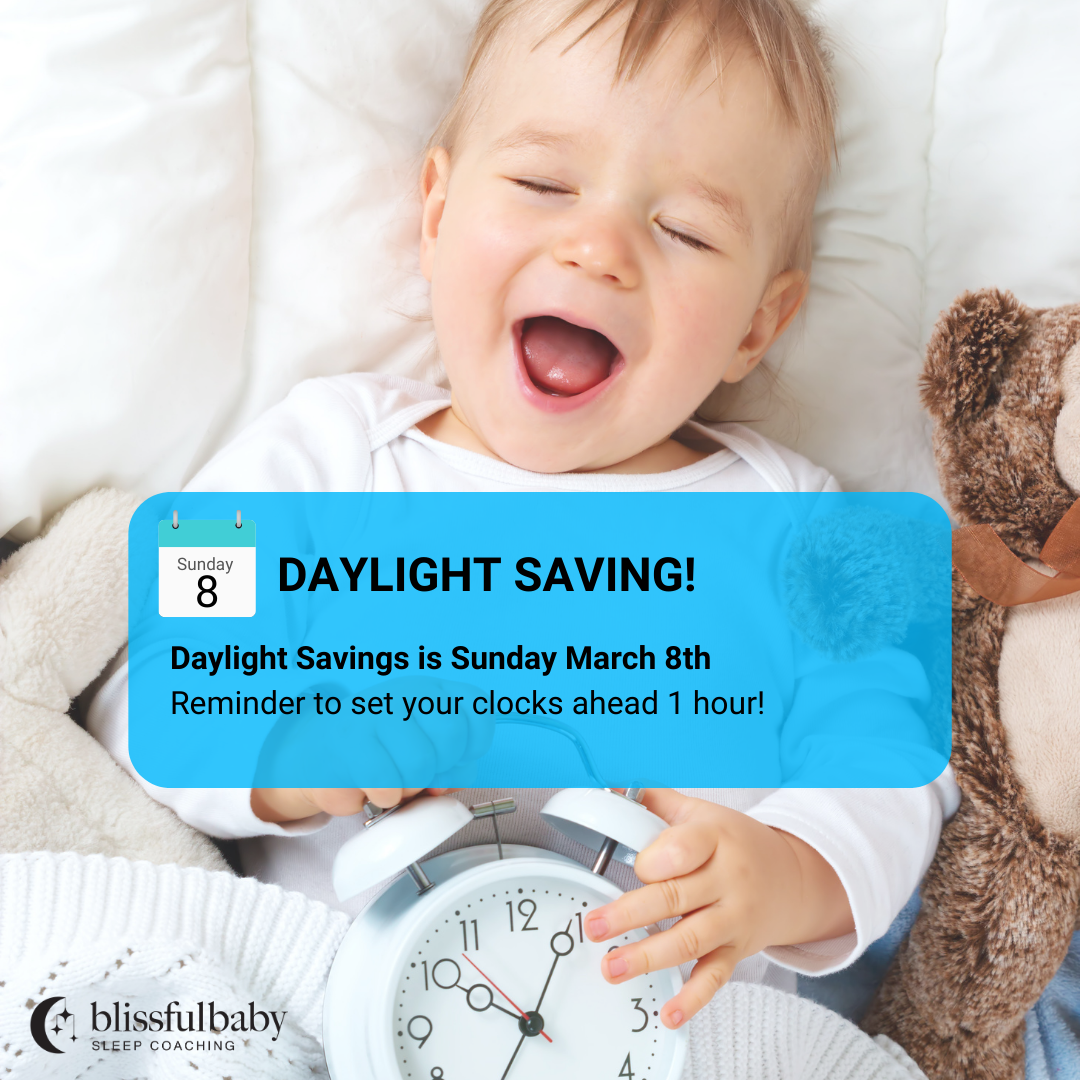
In 2026, Daylight Saving Time begins on Sunday, March 8.
At 2:00 a.m., the clocks move forward one hour.
Which means your child’s 7:00 a.m. wake-up suddenly feels like 6:00 a.m. to their body.
And if you’ve ever lived through spring daylight savings with a baby or toddler, you know: this isn’t “just one hour.”
It can feel like jet lag… without the vacation.
The good news? With a gentle, steady approach, most children adjust within a few days. You don’t need drastic schedule changes, cry-it-out, or rigid sleep boot camps.
Let’s walk through exactly how to handle spring forward 2026, calmly and confidently.
Why Spring Forward Feels Harder Than Fall Back
When we “fall back” in November, children get what feels like extra sleep.
When we “spring forward,” we’re asking their bodies to fall asleep earlier than their internal clock is ready for.
That’s the tricky part.
Your child’s circadian rhythm doesn’t change just because the clock does. For a few days, bedtime may feel too early, mornings may feel too early, and naps can get wobbly.
This is normal.
It’s not a regression. It’s a temporary rhythm shift.
Option 1: Do Nothing (Yes, Really)
If your child is generally a flexible sleeper, you can simply switch to the new clock time on March 8 and allow their body to adjust naturally.
Most children adapt within 3–7 days.
What this looks like:
Bedtime stays the same by the clock.
Wake-up stays the same by the clock.
You protect sleep pressure and keep routines consistent.
You get outside in morning light to help reset their internal clock.
This works especially well for:
Babies under 6 months
Toddlers with solid sleep foundations
Families who prefer minimal schedule tinkering
Consistency is more powerful than perfection here.
Option 2: Gradually Shift Before March 8
If your child is sensitive to overtiredness or early waking, you can shift the schedule slowly in the 4–5 days leading up to Sunday, March 8.
Starting Wednesday, March 4:
Move bedtime 10–15 minutes earlier each night.
Shift naps earlier by the same amount.
Wake your child 10–15 minutes earlier each morning.
By Sunday, you’ll already be close to the new time.
This approach feels gentler for:
Toddlers prone to overtired meltdowns
Babies in the middle of a sleep regression
Children who wake very early
Small shifts protect regulation. Big swings often backfire.
What About Early Morning Wake-Ups?
Spring daylight savings can temporarily cause:
5:00–6:00 a.m. wake-ups
Shorter naps
Extra bedtime resistance
Before assuming something is “wrong,” give it 3–5 days.
To support smoother mornings:
Keep the room dark (blackout curtains really help this time of year).
Don’t start the day before your desired wake time.
Expose your child to natural sunlight within 30–60 minutes of waking.
Keep naps age-appropriate to avoid overtired spirals.
Light is the strongest cue for resetting the body clock.
Should You Use Cry-It-Out for the Transition?
Short answer: no.
There’s no need to overhaul your approach or suddenly introduce extinction methods just because of daylight savings.
Spring forward is temporary.
If your family practices gentle sleep coaching, responsive settling, or a no cry-it-out approach, you can absolutely stay consistent through this shift.
Sleep transitions go more smoothly when children feel secure.
A Gentle Spring Forward Plan by Age
Babies (0–6 months)
Follow wake windows. Protect naps. Use light exposure in the morning. Avoid rigid clock watching.
Babies (6–12 months)
Shift gradually if sensitive. Keep bedtime routine predictable. Offer a slightly earlier bedtime for a few days if needed.
Toddlers & Kiddos (1–5 years)
Prep them verbally:
“The clock is changing. We’ll still sleep when it’s dark.”
Keep boundaries steady. Expect 3–5 days of adjustment.
How Long Does It Take to Adjust?
For most children:
Mild disruption: 2–3 days
More sensitive sleepers: 5–7 days
Rarely longer than 10 days
If sleep struggles persist beyond two weeks, there may be a separate schedule or regression issue—not just daylight savings.
A Calm Reframe for Parents
If March 8 feels stressful, here’s your permission slip:
You don’t have to engineer this perfectly.
You don’t have to fix everything in one night.
You don’t have to panic if bedtime runs late for a few evenings.
Children’s bodies are designed to adapt.
Your job isn’t to control every variable.
It’s to stay steady.
And steady is powerful.
Frequently Asked Questions About Spring Daylight Savings
-
Daylight Saving Time begins on Sunday, March 8, 2026, at 2:00 a.m. Clocks move forward one hour.
-
Possibly for a few days. Their body clock may still be on “old time.” Most adjust within a week
-
If you do nothing, keep bedtime the same by the clock. If shifting gradually before March 8, move bedtime 10–15 minutes earlier for several days.
-
For sleep, yes. Spring forward asks children to fall asleep earlier than their internal rhythm prefers.
Are you struggling with sleep after the time change?
If has been 2 weeks and you are still having issues, it might be time for “Sleep Tune-Up” time and you can fill out this form and state you need a sleep tune up call ($150 for 30 min)
Critical Insights: AI And Sleep Coaching For Parents
Let’s be honest, AI is everywhere. From meal planning to mindset coaching, there’s an app or chatbot for everything.
And now, some of these tools are claiming to coach your baby’s sleep.
It sounds convenient, right? Quick answers, instant plans, no appointments.
But when it comes to your child’s sleep, it’s not that simple.
Why AI Tools Can Be Misleading
AI is amazing at gathering information, but it doesn’t understand your child.
Some of the new “AI sleep coaches” are just chatbots trained on surface-level data. They don’t consider your child’s age, temperament, sleep environment, or family schedule and family/parental dynamics.
They can’t tell when your little one is overtired, teething, or going through a regression—and that ALL matters.
Sleep coaching isn’t one-size-fits-all. It’s about behavior, biology, and connection. Without that human understanding, an AI tool can easily miss the mark.
The Hidden Risk of AI Sleep Coaches
Lately, I’ve seen a growing trend—people who are not trained sleep coaches creating AI “bots” or GPTs and selling them as quick-fix solutions.
These untrained creators often mix and match methods without understanding the behavioral science and attachment theory behind sleep. The result can be intermittent reinforcement—a pattern that makes sleep struggles harder to fix and the child will actually cry louder, longer and harder.
Here’s what that looks like: one night, the AI tells you to respond one way; the next night, a different way. Your child receives mixed messages. Over time, this inconsistency can cause more night wakings, more resistance, more tears, more power struggle, more confusion and more stress for parents without seeing any improvement that has the potential to last.
A certified and trained Sleep coach with real world experience knows how to recognize these patterns, pivot the plan, and support progress in a consistent, compassionate way.
A bot simply can’t do that.
Why Credentials Matter
When you hire a sleep coach, you’re trusting someone to guide your family through meaningful change. That’s not just about schedules, it’s about behavior, attachment, and emotional wellbeing.
I’m trained through Kim West’s Gentle Sleep Coach® Program, using methods rooted in sleep science, child development, and attachment theory. Every plan I create is individualized, evidence-based, and built around your family’s values, schedules and comfort level.
If you’re considering a “coach” who uses AI, ask:
Are they certified in pediatric sleep?
Do they offer live, human support?
Can they adjust when your child’s needs change?
Do they understand developmental stages and behavioral patterns?
If those answers aren’t clear, that’s a red flag.
Where AI Can Help (With Oversight)
AI isn’t the enemy, it’s just not the expert.
Used responsibly, it can support the coaching process by helping parents:
Track sleep logs or notice patterns
Organize notes or reminders
Reflect on progress between sessions
But AI should never replace the trained human behind the plan. Think of it like a helpful assistant—not the driver.
The Gentle Truth
Technology is powerful, but your child’s sleep journey deserves more than a one-click plan. Real progress happens when parents are supported with compassion, consistency, and context.
AI can assist, but it can’t connect.
It can process data, but it can’t notice the sparkle, or the struggle, in your child’s eyes.
So before downloading another “AI sleep coach,” remember this: lasting sleep success comes from human understanding, not automation.
Your baby’s sleep is too important to leave to a bot.
Ready to Transform Your Family’s Sleep?
At Blissful Baby Sleep Coaching, I believe that sleep is a learned skill, and every child is capable of learning it—with the right guidance and support.
Whether you’re a working parent juggling deadlines or simply a family in need of rest, know this: there is always help and hope available.
If you’ve been hesitating, wondering if sleep coaching is right for you, let me reassure you: the hardest part is deciding to start. From there, with expert guidance and your dedication, the progress will come quickly. This is your chance to transform your life in a way few other things can.
Ready to take the leap? Let’s talk about how sleep coaching can create your family’s transformation. You deserve this. Your baby deserves this. And your future self will thank you.
Let’s start with an easy first step, schedule a Sleep Strategy Session so me, you and your partner can have an 1 hr long zoom session so I can properly assess the sleep situation and determine if you need one-on-one sleep coaching support.
Let’s get your baby sleeping—and get YOU your sanity back.
If you are still wondering if I can help, please know I do NOT advocate 'cry-it-out'. I am a Gentle Sleep Coach. If you want to learn about my guilt-free and gentle process, please go to these links.
The Blissful Baby Stairway to Sleep
Please join my Sleep is Bliss Tribe in Facebook, Instagram and LinkedIn so we can stay connected and you can continue to get amazing resources on sleep and family wellness.
Sleep is Bliss, Let's Get you more!

The Difference Between Sleep Training and Sleep Coaching
Revelations From A Mother… who loved her sleep coaching experience.

Please know there is a BIG difference between SLEEP TRAINING and SLEEP COACHING!
The entire process of Gentle Sleep Coaching is about an evidence based, proven system to promote a gentle, reassuring, gradual change that results in healthy sleep habits.
Going to sleep independently and peacefully—and staying asleep—is a learned skill. As parents, we sometimes assume that sleeping is a developmental milestone that comes naturally, yet healthy sleep habits are a learned skill. Like any skill, its mastery requires coaching, practice and time. We parents are coaches in countless ways every day, so it is perfectly appropriate to gently and safely coach your child on this skill, too. In teaching it, you give a lifelong gift to your child.
Sleep Coaching is NOT “this terrible awful thing.”
In fact, it is one of the most important and supportive actions you can provide to your child.
Below are some important reflections and revelations from a mother that successfully sleep coached her 18 month old daughter. She shares about overcoming the “sleep coaching bias” and judgments in “the mommy world”
“I was one of the moms that would never let my baby cry. If she hated being held by someone (and in my case, it was anyone besides me), I would take her back right away. I quit my job to be with her, I would do anything for her. I read all the books, and I mean all of them. I was active in a huge moms group and frequented parenting websites.
I started to notice that there were different camps when it came to sleep. It felt very binary- either you let your child cry to sleep and ignored them all night no matter what happened, or you tended to every peep your child made and woke up 3 times a night til they went to kindergarten. I think this is a shame, and Joanna was a nice middle ground in a confusing sleep training world.
I started to learn and understand that change is inevitable, uncomfortable, and good. And children are constantly changing. My daughter might not like riding in a car seat, going to the doctor, learning to sleep, going to school, or being cared for by anyone except mommy, and she may cry because of these transitions. There is no way to avoid some discomfort, and sometimes short term discomfort is okay. Short term stress actually helps brain development. There is a big difference between a child being mad (“I don’t want to put myself to sleep! I want to breastfeed to sleep!”) and traumatized. I had to become comfortable with the fact that my child may be mad sometimes at necessary change, and that may lead to some crying. It was so obvious from the first day that my extremely sensitive daughter was not being traumatized by being taught to sleep, and I frankly resent that there was a huge group of people that pushed that message.
Not to say it wasn’t extremely hard. I had to leave the house. Even Joanna’s gentle methods were hard for me to handle, I had never done something my daughter didn’t like. I was so worried. But with a few weeks my daughter who used to wake up 5 times a night started sleeping 11 hours a night, and has never had issues since. She is growing better, she was in the 5th percentile for height and is now in the 75th. Her attitude is 100% better. My attitude is 100% better. And I came to realize my anxiety about her discomfort had been in the way of my daughter being as healthy and happy as she could be”
-Kate C. Austin, TX. Child was 18 months at time of guilt-free, gentle sleep coaching
Solve your child’s sleep struggles once and for all — so everyone finally sleeps again.
I help sleep-deprived families get where they need to be: well-rested.
There Is No Need To "Cry-It-Out"
I Offer Guilt-Free, Gentle Sleep Coaching
Easy and calm bedtimes, quiet, peaceful nights, reliable naps and confident parenting are yours.
With proven, evidence-based methods, an expert, signature process, and full-service support,
I help you tenderly teach the “skills of sleep” to your child.
I’ve Helped Over 800 Families Sleep Through The Night.
That’s More Than 2,400 Family Members Now Sleeping Better.
Let Me Help Your Whole Family Sleep Better, Too.
Click the button below to schedule a live 45 minute Sleep Strategy Session where you can gain expert insights into how to tackle the sleep struggles once and for all! (small fee applies)
Good News!! The Evidence Is Confirmed: Sleep Coaching Is Safe and Restores Harmony to the Household

Got Kids? Need Sleep?: Evidence Proves Sleep Coaching Is Safe.....Its Time To Make Sleep A Priority for All Family Members.
All evidence is now confirming that all sleep coaching methods and interventions work to improve sleep. The studies have validated that there are no concerning levels of stress and cortisol. The studies have also confirmed that there are no negative long-term outcomes. This is great news because it now gives parents freedom to choose the RIGHT METHODOLOGY FOR THEIR PARENTING STYLE AND VALUES. I personally prefer Gentle Sleep Coaching, which is also known as the Sleep Lady Shuffle or also known as Fading. Gentle Sleep Coaching is a proven methodology that offers parents the opportunity to be in the room with their child while offering verbal and physical assurances. Gentle Sleep Coaching has been proven to minimize tears and frustration. Gentle Sleep Coaching provides substantial Parent Education and insight into the temperament of their child and how that relates to sleep. Peaceful Nights are Possible with the expertise of Joanna Clark of Blissful Baby Sleep Coaching, a trained and certified Gentle Sleep Coach. Below is an article form Aaron Carrroll, Professor of Pediatrics at Indiana University School of Medicine that further explains the different sleep training methodologies and options.
Putting Your Baby to Sleep: Some Advice and Good News
Aaron E. Carroll is a professor of pediatrics at Indiana University School of Medicine who blogs on health research.
For many new parents, a baby who sleeps peacefully through the night is more aspiration than reality.
I remember thinking, after my pregnant wife’s water broke minutes after I went to bed, anguishing really, over one thought as we drove to the hospital: “I’m never going to be well rested again.”
If there’s one thing all new parents wish for, it’s a good night’s sleep.
Unfortunately, infants sometimes make that impossible. They wake up repeatedly, needing to be fed, changed and comforted. Eventually, they reach an age when they should sleep through the night. Some don’t, though. What to do with them continues to be a topic of a heated debate in parenting circles.
One camp believes that babies should be left to cry it out. These people place babies in their cribs at a certain time, after a certain routine, and don’t interfere until the next morning. No matter how much the babies scream or cry, parents ignore them. After all, if babies learn that tantrums lead to the appearance of a loved one, they will continue that behavior in the future. The official name for this approach is “Extinction.”
The downside, of course, is that it’s unbelievably stressful for parents. Many can’t do it. And not holding fast to the plan can make everything worse. Responding to an infant’s crying after an extended period of time makes the behavior harder to extinguish. To a baby, it’s like a slot machine that hits just as you’re ready to walk away; it makes you want to play more.
A modification of this strategy is known as “Graduated Extinction.” Parents allow their infant to cry it out for a longer period each night, until infants eventually put themselves to sleep. On the first night, for instance, parents might commit to not entering the baby’s room for five minutes. The next night, 10 minutes. Then 15, and so on. Or, they could increase the increments on progressive checks each night. When they do go in the room, it’s only to check and make sure the baby is O.K. — no picking up or comforting. This isn’t meant to be a reward for crying, but to allow parents to be assured that nothing is wrong
Babies cry for a reason. They come from warm, enclosed, snug wombs where they feel their mothers' constant protection. They exit the womb...
It appears this study had no control group. Was there a "no intervention" group, where families just kept doing what they'd been doing --...
There are pros and cons to the "family bed" solution, but I can tell you one thing from experience. Everyone sleeps. The baby doesn't have...
Another choice is “Bedtime Fading.” The point of this plan is to teach your children how to fall asleep on their own at bedtime, in the hope that if they develop this skill, when they wake up in the middle of the night they’ll choose to employ it rather than call for you. With fading, you temporarily set bedtime later than usual and preface it with a good bedtime routine. Your babies learn that bedtime is fun, and have little trouble falling asleep because they’re more tired than usual. Then you move their bedtime earlier and earlier, so that infants learn how to put themselves to sleep when they are less and less tired.
A fourth method is “Scheduled Awakenings.” In this method, a parent tries to disrupt spontaneous awakening by getting up in the middle of the night to wake children 15 to 30 minutes before they usually wake up on their own. They then help the baby fall back asleep. The scheduled awakenings are later phased out.
Of course, even with fading and scheduled awakenings, it’s possible that your baby will wake up in the middle of the night, screaming. Then you face a choice: Go to them or wait it out?
Some people always choose to comfort the child. They think that making a baby cry it out is inhumane and could even lead to psychological problems. Others feel that giving in to babies prevents them from learning needed skills and leads to later problems.
A final thing doctors can do is “Parental Education,” which is closer to prevention. It involves talking to parents about many of these options, especially training infants to fall asleep on their own, before problems develop.
As a pediatrician, the first thing I do with parents who are experiencing problems is calm them down. Sometimes it feels as if it will never go away, but I try to remind them that few teenagers have this issue. They go to bed fine, and if they wake up in the middle of the night, they go back to sleep without anyone’s help. This almost always, eventually, gets better.
On the other hand, I don’t want to minimize the short-term problems for parents. Nor do I want to do nothing. Sleep deprivation leads to significant and serious consequences in adults. A 2008 study published in Pediatrics found that mothers of infants with sleep problems, in which no intervention was tried, were more likely to report symptoms of clinical depression when their child was 2 years old. Sleep problems also lead to significant parental stress, and, potentially, physicalpunishment.
The good news is that almost all interventions work. In 2006, a systematic review was published in the journal Sleep that examined all the relevant research on the efficacy of these interventions. Ninety-four percent of the 52 reviewed studies found that the interventions led to improved sleep, and more than 80 percent of children who were treated improved significantly.
The strongest evidence supported the extinction method and parent education (i.e., prevention). Still, there was evidence that also supported the graduated extinction, fading and scheduled awakenings methods.
People become surprisingly heated about which method to use. This isn’t just because they think one works better than the other, but also because they think some are harmful. They worry about the long-term effects of some methods. Those concerns may be overblown, though. A small study published recently followed children who were randomly sorted to use graduated extinction, fading or parent education. Besides looking at the effectiveness of the intervention on sleep, researchers measured the cortisol hormone in infants’ saliva (as a measure of stress) as well as mothers’ moods and stress.
Again, all of the interventions worked to improve sleep. More important, none caused any concerning levels of stress. This confirmed the findings of two previous studies that found that infant sleep problems, and the interventions used to remedy them, do not predict long-term outcomes, even at 6 years of age.
Parents become stressed about infants who don’t sleep well. That’s understandable. What they don’t need to stress about is that fixing it will cause more harm or have long-term negative consequences. A good night’s sleep makes almost everything better.
Aaron E. Carroll is a professor of pediatrics at Indiana University School of Medicine who blogs on health research and policy at The Incidental Economist and makes videos at Healthcare Triage. Follow him on Twitter at @aaronecarroll.
Solve your child’s sleep struggles once and for all — so everyone finally sleeps again.
I help sleep-deprived families get where they need to be: well-rested.
There Is No Need To "Cry-It-Out"
I Offer Guilt-Free, Gentle Sleep Coaching
Easy and calm bedtimes, quiet, peaceful nights, reliable naps and confident parenting are yours.
With proven, evidence-based methods, an expert, signature process, and full-service support,
I help you tenderly teach the “skills of sleep” to your child.
I’ve Helped Over 800 Families Sleep Through The Night.
That’s More Than 2,400 Family Members Now Sleeping Better.
Let Me Help Your Whole Family Sleep Better, Too.
Click the button below to schedule a live 45 minute Sleep Strategy Session where you can gain expert insights into how to tackle the sleep struggles once and for all! (small fee applies)

ANOTHER WELL-RESTED MOM TELLS HER STORY
Well-Rested Mom Tells her Story of Gentle Sleep Coaching

Well-Rested Mom Tells her Story
Parents in Texas came to me utterly exhausted and overwhelmed after their pediatrician was no longer to help them. That same pediatrician referred them to me. The now well-rested, happy mother and father describe their story!!!
Before Gentle Sleep Coaching, list 2-3 most difficult issues that resulted in your child not sleeping.
Just weeks after Ella was born she developed what specialists called “extreme colic.” She was very uncomfortable and would scream and cry for hours and hours on end day and night inconsolably. So much so she would shake and choke and even momentarily stop breathing. Doctors don’t fully understand colic or what causes it but pretty much they just say “ they will grow out of it.” In addition to this, she developed reflux and would throw up constantly and was in pain from the reflux. Coupled with these medical conditions she is a very highly sensitive and high alert baby and was not able to regulate herself and she was waking up every 1-2 hrs at night crying hysterically and needed mom to put her back to sleep with either bottle or rocking or both. With reflux being the #1 sleep disrupter, this was leading to Ella not sleeping well at all along with babies just not knowing how to regulate and self soothe themselves to sleep.
How were the above problems impacting your life.
As a mom and a protector, this was devastating because I felt there was nothing I could do to help my baby girl. I felt like a failure and even developed post-pardum depression and had anxiety every evening leading up to the night time because I knew it would be a long dreadful and painful night. Even the little bit Ella would sleep at night, I still was not able to sleep due to anxiety. I began to unravel physically as I started getting sick from no sleep. I also came apart emotionally and psychologically due to lack of sleep. This affected my marriage to my wonderful loving and supportive husband.
What finally had your say “enough is enough” that inspired you to reach out for help by working with a sleep coach.
Even with my husbands support I was at the end of my rope and I didn’t think I could take another day because I wasn’t sleeping at night or during the day for weeks and months on end. I called Joanna out of pure desperation and prayed she could help my family. Then in the midst of all of this when Ella was just 5 ½ months old, I found out I was pregnant with # 2. While babies are always a miracle and a blessing this one was not planned and unexpected. While I reached out to Joanna just a couple days before we found out this news, the news of #2 led to an even more desperate and critical situation
What was one your favorite aspects of Gentle Sleep Coaching and working with Joanna Clark of Blissful Baby Sleep Coaching.
I was really impressed and appreciated more than anything how much time and effort Joanna took to understanding our story and my baby and the entire puzzle pieces of our situation. She became a team member on behalf of “ Ella’s team to her sleep and therefore give everyone the gift of sleep. You will never fully understand how vital sleep is until you are deprived from it. She had me fill out a lengthy series of questions to understand every detail of Ella and her demeanor, her health and background. The questions also included questions about me and my husband who play a big part of the puzzle fitting together. I felt assurance and very comfortable knowing Joanna was going to help us train Ella until we reached our goal. I didn’t think twice about the money spent because it is nothing compared to the gift and the knowledge and strength it gave us. I felt supported by Joanna and I appreciated the follow up calls every day. I always had questions and she never hesitated to answer with confidence and sincerity. Also, nothing was set in stone as we tweaked the plan as we went depending on how comfortable we felt as parents and how Ella did the night before. There is a true science behind babies sleep and having a knowledgeable professional like Joanna coach you through it and hold your hand while you are falling apart at the seams is life saving and life changing and you can’t put a dollar amount on that. Little Ella had a lot of “challenges” stacked against her from the start. She had colic, reflux, very alert and hard to calm down, met her milestones very early, and also rejecting the sleep crutches that used to work. All of these are big time sleep disrupters. Even with all of this, with the help and gentle coaching of Joanna, Ella was sleeping through the night and sleeping 11-12 hours without feeding or any sleep crutches in just 2 weeks! All in her own crib. This is all truly mind blowing but Joanna helped us by giving us a plan that we felt comfortable with and could trust. It was very gentle which is huge for a mom who can’t stand to hear or let her baby cry. Teaching and training your baby to teach themselves to self soothe themselves back to sleep and sleep through the night without mom and dads help is critical for their health and development as well as the parents and other siblings in the house. It’s the best gift you can give your baby and yourself and spouse
Now that your child is sleeping well, what are some of the tangible and specific results you have experienced in your life.
Since Ella has been sleeping through the night, I am sleeping so well and my marriage is restored. Ella now goes to bed at 6:30 pm and we even have our nights back to enjoy a meal and each other. I am not irritable or over whelmed any longer and I also no longer need medication for post pardum depression. I feel like a new woman and also like myself again. I can enjoy Ella so much more now and she is so much of a happier baby during the day!!
The plan worked so well that we had some time left to nap train which is crucial for babies night time sleep. The nap training went well and Ella is taking 3 solid naps a day while putting herself to sleep in her crib and sleeping 1-2 hrs per nap!
I can say I’m a big believer in Joanna’s approach to Gentle Sleep Coaching and highly recommend her for anyone struggling with their newborn, infant, or toddlers sleep!
Solve your child’s sleep struggles once and for all — so everyone finally sleeps again.
I help sleep-deprived families get where they need to be: well-rested.
There Is No Need To "Cry-It-Out"
I Offer Guilt-Free, Gentle Sleep Coaching
Easy and calm bedtimes, quiet, peaceful nights, reliable naps and confident parenting are yours.
With proven, evidence-based methods, an expert, signature process, and full-service support,
I help you tenderly teach the “skills of sleep” to your child.
I’ve Helped Over 800 Families Sleep Through The Night.
That’s More Than 2,400 Family Members Now Sleeping Better.
Let Me Help Your Whole Family Sleep Better, Too.
Click the button below to schedule a live 45 minute Sleep Strategy Session where you can gain expert insights into how to tackle the sleep struggles once and for all! (small fee applies)

Mega Success Story: Family Life Improves With Proper Sleep.
A Mega Success Story...Find Out How This Family's Life Changed with Gentle Sleep Coaching

I had to share this incredibly inspiring success story about a family that had a premature baby and many sleep crutches. This is a wonderful example of all the benefits of Gentle Sleep Coaching with Blissful Baby Sleep Coaching.
Before Gentle Sleep Coaching, list 2-3 most difficult issues that resulted in your child not sleeping.
Our child was born three months prematurely and as a result his sleeping and eating cycle stayed on a three hour rotation for almost 6 months. Because he was born so early he was not able to breast feed, so I exclusively pumped for about nine months and my husband and I would be up all night long to either pump (me) or feed (him) our son. This routine created many unique sleep challenges and crutches for our family that took a severe toll on our sleep and overall wellness after all of those months. Our breaking point occurred when we found ourselves in a desperate 1 to 2 hour cycle at night of crying jags and arousals. We offered bottles, rocking, holding, midnight car rides, our bed...anything to get our baby to sleep. It seemed that a new tactic would work for a short period of time, but eventually would fail. Fletcher was obviously over tired, but lacked the ability to rest and we did not know how to soothe him beyond the crutches that we had already tried. We were insistent that we did not want him to 'cry it out' in any way and that we would 'love him to sleep', but after months of regression and worsening sleep issues it became apparent that our methods were not what our son needed. Day time sleep was also a problem. Our baby would only sleep if he was held, being driven around, or at times if I was running with him in a jog stroller (but I could not stop or he would wake up) and at best a nap would last about 30-45 minutes. The whole routine was exhausting!
How were the above problems impacting your life…list as many as you can.
My husband and I were extremely sleep deprived as a result and lived in a constant fog. We were short with one another and found ourselves functioning in a day to day survival mode just to get through. I also developed an anxiety around sleep and I especially began to fear night time because I knew too well the desperate feeling of getting through another long night with such broken sleep. I felt helpless to soothe my baby and I just never knew what would work or for how long it would last. When we would start the day I felt defeated because I was just so tired already. We wouldn't leave him with a babysitter because we didn't want to put anyone through his crying jags and because he couldn't be put down --it would just be too difficult. We were isolated and it was very lonely.
What finally had your say “enough is enough” that inspired you to reach out for help by working with a sleep coach.
We hit rock bottom - we needed to be able to sleep. Our son was doing well and growing and thriving, but we were still stuck in a terrible sleep cycle. We ran out of ideas and simply were exhausted. We had a rough month of colds and three to four total hours of sleep per night stretches and knew we couldn't hang on. We also had a cross country move quickly approaching and wanted to get through this issue before we had new changes and an extended time of transition.
What was one your favorite aspects of Gentle Sleep Coaching and working with Blissful Baby Sleep Coaching.
Joanna is awesome! She is funny and bright and offers a sparkly light at the end of the tunnel (it was a long tunnel for us :). I immediately had hope after speaking with her for only 15 minutes. She is so knowledgeable and explained the science behind sleep cycles and gave us concrete information regarding how much sleep our baby needed, his sleep windows, and what to expect throughout the sleep training. She is empathetic and supportive and her confidence is contagious. We were so exhausted in the beginning that we needed someone to tell us exactly what to do, how to do it, when to do it and why and Joanna absolutely did all of these things.
Now that your child is sleeping well, what are some of the tangible and specific results you have experienced in your life.
Our baby has been sleeping in his crib from 7 pm until 6 am! We decided to continue one feeding at night so he does wake for that around 1 AM, but it is quick and predictable and lasts about 10 minutes total. He has hit new milestones this week (standing and crawling) so he has had a few new arousals but we approach these with our tools from sleep training and have seen progress already. I no longer have anxiety about the night because I know what to do should this situation arise and for the most part our evenings are very predictable these days. We have time to ourselves once he goes to bed at night! I feel So relieved to watch him fall happily asleep in his crib by himself ... it is an amazing feeling.
Solve your child’s sleep struggles once and for all — so everyone finally sleeps again.
I help sleep-deprived families get where they need to be: well-rested.
There Is No Need To "Cry-It-Out"
I Offer Guilt-Free, Gentle Sleep Coaching
Easy and calm bedtimes, quiet, peaceful nights, reliable naps and confident parenting are yours.
With proven, evidence-based methods, an expert, signature process, and full-service support,
I help you tenderly teach the “skills of sleep” to your child.
I’ve Helped Over 800 Families Sleep Through The Night.
That’s More Than 2,400 Family Members Now Sleeping Better.
Let Me Help Your Whole Family Sleep Better, Too.
Click the button below to schedule a live 45 minute Sleep Strategy Session where you can gain expert insights into how to tackle the sleep struggles once and for all! (small fee applies)

Great Success Stories: Tales from Grateful Clients!
Success Stories: Tales from Grateful Clients

Sleep Baby=Happy Baby=Happy Mommy!
SLEEP IS BLISS....LET'S GET YOU SOME MORE!
It is so wonderful to hear parents tell their "before and after" sleep stories. Here are two inspiring stories that prove peaceful nights are possible!!! I have helped over 500 clients...I can help you too. Don't hesitate to reach out to talk live and find out how Gentle Sleep Coaching can work for your family. http://www.blissfulbabysleepcoaching.com/do-i-need-a-sleep-coach/
TODDLER SLEEP
Kathleen P. from GA: Child was 2 years old at time of sleep coaching
"When our daughter was 18 months old, she took an hour on average to fall asleep for naps and bedtime, and then woke every 2-4 hours. She was sleeping on our guest mattress on the floor because she couldn’t fall asleep without me (her mother) right beside her, and often wouldn’t sleep unless I stayed the rest of the night. She was completely dependent upon me to sleep, so much so that she’d scream until I arrived if my husband tried to help alone. I was beyond exhausted and really had no idea what to do. I was afraid of sleep training, fearing it would ruin her trust and secure attachment with me. Friends and family had told me “She’ll eventually sleep through the night on her own”, so I kept waiting.
I finally called Joanna out of desperation after a particularly horrible night of no sleep. It had to change or I felt like moving out! I immediately felt comfortable with Joanna, as she reassured me she could help and that she understood where we were coming from. She thoroughly explained her approach and the sleep science behind why it works. As a team of 3, she helped us create a sleep plan that was exactly what my daughter needed. Because of my daughter’s age and numerous sleep crutches, we all thought it would take many weeks to train her. We were thrilled when she was sleep trained after only 11 days, and was nap trained after 12. She now sleeps a full 12 hours at night in her crib, and requires no participation from us to fall asleep. It is the true definition of bliss.
I want to shout it from the rooftops that sleep training is beneficial and necessary! I wish I had known that falling asleep on your own is a learned skill, not one you just wait for your child to figure out. I strongly urge any parent struggling with exhaustion to please call Joanna and trust her. Her approach is truly gentle, and has saved our sanity and happiness as parents. We could not have done this without her, and are so happy with what we’ve achieved with her guidance."
OLDER BABY SLEEP
M. Miller, Michigan: Child was 7 month old at time of sleep coaching
"We called Joanna for our second child. Our first kid is a great sleeper, we never expected to have such a hard time with our second. We were exhausted confused and we did not know what to try next!!! A friend of mine told me about Blissful Baby Sleep Coaching and I immediately called. Joanna was great and I could tell from our initial conversation that she will be able to help us. We followed Joanna’s Plan and after 3 days our 7 months old baby was sleeping trough the night and napping. Joanna and her method was a god send, she help us every step of the way, week days and weekends you name it, she was there.
Thank you Joanna for giving our son the gift of sleep. Merci Merci!!!!!"
Solve your child’s sleep struggles once and for all — so everyone finally sleeps again.
I help sleep-deprived families get where they need to be: well-rested.
There Is No Need To "Cry-It-Out"
I Offer Guilt-Free, Gentle Sleep Coaching
Easy and calm bedtimes, quiet, peaceful nights, reliable naps and confident parenting are yours.
With proven, evidence-based methods, an expert, signature process, and full-service support,
I help you tenderly teach the “skills of sleep” to your child.
I’ve Helped Over 800 Families Sleep Through The Night.
That’s More Than 2,400 Family Members Now Sleeping Better.
Let Me Help Your Whole Family Sleep Better, Too.
Click the button below to schedule a live 45 minute Sleep Strategy Session where you can gain expert insights into how to tackle the sleep struggles once and for all! (small fee applies)